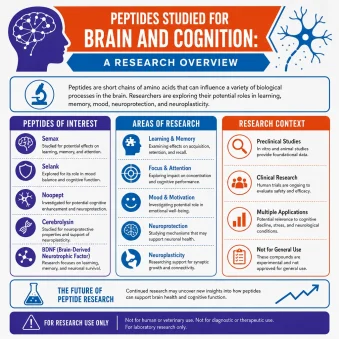



Peptides Studied for Brain and Cognition: A Research Overview
Several research peptides are studied for how they affect the brain's plasticity machinery in animal and cell models. This research-use-only overview compares four of the most-studied, Semax, Dihexa, PE-22-28, and P21, explains the very different mechanisms behind them, and links to the full reference for each. It also states plainly what these models do and do not prove.
Research-use-only disclaimer: The peptides discussed here are intended strictly for in-vitro and laboratory research use and are not intended for human or veterinary use in that context. Every finding below is drawn from cell-culture or animal models and is described in hedged, mechanistic terms. Nothing here is medical advice or a claim of cognitive benefit in people.

TL;DR
The most-studied research peptides for brain and cognition reach the same goal, more synaptic plasticity, by different routes: Semax raises BDNF/TrkB signaling, Dihexa potentiates HGF/c-Met synaptogenesis, PE-22-28 blocks the TREK-1 potassium channel to disinhibit serotonergic neurons, and P21 promotes neurogenesis through a CNTF-derived route. All four are research-use-only, mostly preclinical, and none is a proven human nootropic.
Which Peptides Are Studied for Brain and Cognition?
Four compounds show up most often in the brain and cognition research literature, and each takes a different path to the same destination. Semax raises a neurotrophin. Dihexa amplifies a growth factor. PE-22-28 blocks an ion channel. P21 pushes the birth of new neurons. Grouping them this way makes the landscape easy to read: it is not one mechanism but several, all converging on synaptic plasticity in models.
How Do Neurotrophic and Cognition Peptides Work?
The shared idea is plasticity, the brain's ability to strengthen and rebuild connections. Neurotrophins such as BDNF are central to that process, so several of these peptides either raise BDNF directly (Semax) or promote it downstream (P21). Others engage the machinery around it: growth-factor signaling that builds new synapses (Dihexa via HGF/c-Met), or ion-channel control that changes how easily neurons fire (PE-22-28 via TREK-1). Different levers, one theme.
Side-by-Side Comparison
| Peptide | Main target / mechanism | Key model readout | Full reference |
|---|---|---|---|
| Semax | ACTH(4-10) analog; raises BDNF and TrkB signaling | ~1.4x BDNF, ~1.6x TrkB in rat hippocampus; neuroprotection | Semax |
| Dihexa | Angiotensin IV analog; potentiates HGF / c-Met | c-Met phosphorylation; hippocampal synaptogenesis | Dihexa |
| PE-22-28 | Spadin analog; blocks TREK-1 potassium channel | Serotonergic disinhibition; raised BDNF/PSD-95 | PE-22-28 |
| P21 (P021) | CNTF-derived; promotes neurogenesis | Dentate-gyrus neurogenesis; lower tau; memory rescue | P21 |
Semax (BDNF / TrkB)
Semax is a heptapeptide analog of the ACTH(4-10) fragment. Its clearest mechanism is raising hippocampal BDNF and activating its TrkB receptor, which feeds the MAPK/ERK, PI3K/Akt, and PLC-gamma pathways behind plasticity and neuronal survival. It is studied in neuroprotection models and is a registered medicine in Russia. Full detail: the Semax research reference.
Dihexa (HGF / c-Met)
Dihexa is a metabolically stabilized angiotensin IV analog that binds HGF and potentiates c-Met signaling, driving hippocampal spinogenesis and synaptogenesis in models. Its loss-of-function controls are strong, but a key paper carries a 2021 journal Notice of Concern, which the full reference covers honestly: the Dihexa research reference.
PE-22-28 (TREK-1)
PE-22-28 is a seven-residue spadin analog that blocks the TREK-1 potassium channel with very high affinity. By reducing that leak current it can disinhibit dorsal-raphe serotonergic neurons and, downstream, raise BDNF and PSD-95, markers of synaptic plasticity. Full detail: the PE-22-28 research reference.
P21 (CNTF-Derived Neurogenesis)
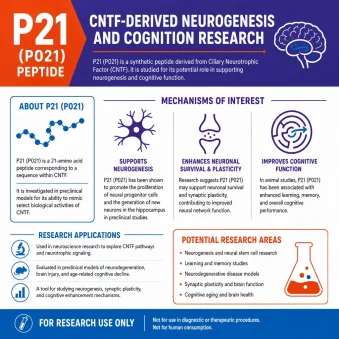
P21 (P021) is a small CNTF-derived peptide engineered to promote neurogenesis without CNTF's appetite-suppressing effect. In Alzheimer's-model mice it increased dentate-gyrus neurogenesis, raised BDNF, reduced tau pathology, and rescued memory, though all of it comes from a single research group. Full detail: the P21 research reference.
What They Share, and What Is Not Established
All four converge on synaptic plasticity, and several raise BDNF one way or another. That is the honest through-line. The equally honest limit is that this is preclinical research: much of it is animal and cell data, some of it (P21) comes from a single group, one central Dihexa paper carries a Notice of Concern, and none of these four has an established human evidence base as a cognitive compound. For a research audience, they are useful, mechanistically distinct tools for studying plasticity, not proven nootropics.
Frequently Asked Questions
Which peptides are studied for brain and cognition?
The most-studied are Semax (BDNF/TrkB), Dihexa (HGF/c-Met synaptogenesis), PE-22-28 (TREK-1 blockade), and P21/P021 (CNTF-derived neurogenesis). All are research-use-only.
What do these peptides have in common?
They converge on synaptic plasticity, and several raise BDNF, but they use very different mechanisms to get there, from neurotrophin signaling to ion-channel blockade to neurogenesis.
Are these proven to improve cognition in humans?
Largely no. The evidence is mostly preclinical, some from single groups, and human data are limited or absent for these specific compounds.
Are these approved for human use?
No. They are research-use-only compounds studied in cell and animal models, not drugs or treatments.
References
- Dolotov OV, et al. Semax regulates BDNF and trkB expression in the rat hippocampus. Brain Res. 2006. Reference
- Benoist CC, et al. Procognitive and synaptogenic effects of angiotensin IV-derived peptides (HGF/c-Met). J Pharmacol Exp Ther. 2014.
- Djillani A, et al. Shortened spadin analogs (PE-22-28) and TREK-1 inhibition. Front Pharmacol. 2017. PMC5601071
- Kazim SF, Iqbal K, et al. Neurotrophic compound P021: neurogenesis and cognition in Alzheimer models. PMC. PMC5488423
Final disclaimer: This article is an educational research reference. The peptides discussed are sold and studied for laboratory research use only and are not approved by any regulatory authority for human or veterinary use. Statements have not been evaluated by the FDA. Nothing here should be interpreted as medical advice or a cognitive-benefit claim.
Mechanistic descriptions are observations from cell and animal models that may not generalize or replicate, and some cited data carries a journal Notice of Concern. Always verify the legal status of any research compound in your jurisdiction before purchase or use.